Thoreau and A New Vision for Civilization and Nature
By Daniel B. Botkin

In No Man’s Garden, ecologist Daniel Botkin takes a fresh look at the life and writings of Henry David Thoreau to discover a model for reconciling the conflict between nature and civilization that lies at the heart of our environmental problems. He offers an insightful reinterpretation of Thoreau, drawing a surprising picture of the “hermit of Walden” as a man who loved wildness, but who found it in the woods and swamps on the outskirts of town as easily as in the remote forests of Maine, and who firmly believed in the value and importance of human beings and civilization.
Where to buy:
paperback:
Amazon
Barnes & Noble
ebook
Amazon Kindle
B&N Nook
Apple iBookstore
Kobo
Sony Reader Store
Botkin integrates into the familiar image of Thoreau, the solitary seeker, other, equally important aspects of his personality and career-as a first-rate ecologist whose close, long-term observation of his surroundings shows the value of using a scientific approach, as an engineer who was comfortable working out technical problems in his father's pencil factory, and as someone who was deeply concerned about the spiritual importance of nature to people.
Hardcover, Island Press; 1ST edition $25 (October 1, 2000)
ISBN: 1559634650
Original cover
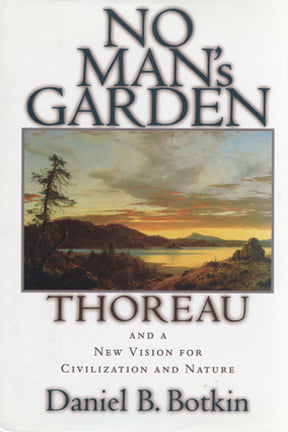
–Amazon.com

On August 31, 1846, Henry David Thoreau left his home in Concord, Massachusetts and went to the woods of Maine to discover wilderness for himself, rather than take other people’s word for what it was like and what it meant. Direct, personal experience is the most obvious way to learn about nature and one’s connection to it, and it was Thoreau’s primary approach to knowledge. On this day he sought to climb to the summit of Mount Katahdin to confront nature at its rawest. At 5267 feet, Katahdin is the tallest mountain in Maine, and the third highest mountain east of the Rockies.
Thoreau arrived on the slopes of Katahdin in part because of his mentor, Ralph Waldo Emerson. Emerson was one of a group of intellectuals around Concord and Boston who had adopted the philosophical-religious doctrine of Transcendentalism. Among its precepts were: the central role of biological nature in religion and human life in general; the belief that nature could be read spiritually; and that studying God in Nature could substitute for reading the Bible. Another precept was the belief that nature was benign and concerned about human beings. While his intellectual colleagues in this group were content to sit in their drawing rooms and discuss these beliefs -- in fact they believed that insight was superior to both experience and logic as a path to basic truths -- Thoreau set off to explore their ideas, to test the truth for himself through first-hand observation. That is why he found himself ascending the mountain. He hoped to achieve a spiritual connection with benign nature through direct experience with it, and by reading it as one would the Bible.1
If you were to put a pin in the geographic center of Maine, you would come close to the location of Mount Katahdin. It is part of the Appalachian Mountains -- the backbone of eastern North America, extending two thousand miles from Labrador to Georgia. The Appalachians are among the oldest mountains in the world, with some of the exposed bedrock more than 600 millions years old — predating the Cambrian era — the time of the first great explosion in the diversity of animals. Today Mount Katahdin is the northern end of the Appalachian National Scenic Trail, a trail developed by hikers independent of the government in the 1920s and 1930s and made part of the National Trail System by Congress in 1968. Katahdin forms a massive mountain with several peaks rising more or less isolated within the rolling and flat terrain of the interior boreal forests of Maine.2
On September 7, 1846, Thoreau climbed partway up the mountain, reaching an elevation of 3800 feet. "The wood was chiefly yellow birch, spruce, fir, mountain-ash, moose-wood. It was the worst kind of traveling; sometimes like the densest scrub-oak patches with us,"3 he wrote, the “us” referring to residents of Concord, Massachusetts and the surrounding countryside. Part way up, Thoreau left his companions to find and make a camp while he continued ascending to find a route to the summit for the next day. He was thus alone in the wilderness. He found himself "in a deep and narrow ravine, sloping up to the clouds, at an angle of nearly forty-five degrees, and hemmed in by walls of rock, which were at first covered with low trees, then with impenetrable thickets of scraggy birches and spruce-trees, and with moss.”4 He was climbing through the stunted, gnarled and twisted trunks of the last trees able to survive at those high altitudes, a shrub-like growth called krumholz. He climbed “on all fours over the tops of ancient black spruce.” He found “their tops flat and spreading, and their foliage blue, and nipped with cold, as if for centuries they had ceased growing upward against the bleak sky, the solid cold.”5
There were holes in the krumholz. Once slumping through, Thoreau saw down “into a dark and cavernous region,” and thought that the “holes were bears' dens, and the bears were even then at home,” he continued. “This was the sort of garden I made my way over,” he wrote, “certainly the most treacherous and porous country I ever traveled."6 It was seeming less and less like a benign environment.
He was one of the first people to make it this far up Mount Katahdin, no simple feat given the isolation of the peak and the limitations of the equipment available to him. The Indians believed that the mountain was too sacred to climb and rarely attempted it, and few Europeans had yet come this way with the curiosity and sense of adventure to climb the mountain. Through this difficult wilderness he struggled, “pulling myself up by the side of perpendicular falls of twenty or thirty feet, by the roots of firs and birches, and then, perhaps, walking a level rod or two in the thick stream . . . ascending by huge steps, as it were, a giant's stairway, down which a river flowed.”7
Briefly he achieved what so many seek in such a climb today: a view of the countryside. “I had soon cleared the trees and paused on the successive shelves to look back over the country,”8 he wrote. But the view was “almost continually draped in clouds. ”9 . . .
The next day, Thoreau resumed his climb. He never quite reached the summit of Mount Katahdin, but he did reach a tableland between two peaks, later named South and Baxter. The tableland is much like the summit in its rawness and exposure. There Thoreau found that he was "deep within the hostile ranks of clouds."10 The clouds blew in and out. "It was, in fact, a cloud factory . . . Occasionally, when the windy columns broke into me, I caught sight of a dark, damp crag to the right or left; the mist driving ceaselessly between it and me.”11
Thoreau was well read in the classics, and the summit of the mountain began to seem more like an ancient, pre-Christian saga than a replacement for the Bible. He wrote melodramatically, that “It reminded me of the creations of the old epic and dramatic poets, of Atlas, Vulcan, the Cyclops, and Prometheus” not of a benign, Christian God, and he felt estranged here from nature in a way he had not felt before. “It was vast, Titanic, and such as man never inhabits.” Standing within this awesome setting, he, a human being, seemed less significant as nature appeared more powerful. He felt “more lone than you can imagine.” In the thinner air on the mountaintop “Vast, Titanic, inhuman nature” had him “at a disadvantage, caught him alone.” He felt that he had lost “some of his divine faculty,”12 one of the very things he had sought to capture and understand on the mountain.
The setting took on the aspect of a theater in which Thoreau became a player and Nature became the star. He gave Nature a speaking part.
She seems to say sternly, Why came ye here before your time. This ground is not prepared for you. Is it not enough that I smile in the valleys? I have never made this soil for thy feet, this air for thy breathing, these rocks for thy neighbors. I cannot pity nor fondle thee here, but forever relentlessly drive thee hence to where I am kind. Why seek me where I have not called thee, and then complain because you find me but a stepmother? Shouldst thou freeze or starve, or shudder their life away, here is no shrine, nor altar, nor any access to my ear.13
On the summit of Katahdin, Henry David Thoreau discovered that wild nature was overpowering. “This was that Earth of which we have heard, made out of Chaos and Old Night. Here was no man's garden, but an unhandseled globe. It was not lawn, nor pasture, nor mead, nor woodland, nor lea, nor arable, nor waste land.” 14
So why did Thoreau climb the mountain? It is easy to imagine him wondering this very thing as he struggled in the clouds among the house-sized boulders, alongside steep cliffs, atop stiff and stunted black spruce. On his way down Thoreau noticed "Now and then some small bird of the sparrow family” that “would flit away before me, unable to command its course, like a fragment of the gray rock blown off by the wind.”15 The bird, perhaps, was a metaphor for how he felt about his own precarious situation. "Perhaps I most fully realized that this was primeval, untamed, and forever untamable nature, or whatever else men call it, while coming down this part of this mountain." 16
The immediate, specific reason that he came to the mountain was to find nature at its essence, to discover a benign, caring nature, a book of nature that would set him spiritually at peace with nature and with himself. Within New England, Katahdin, untrammeled by human beings, at that time beyond the reach of human-lit fires or air pollution, would have seemed to be the ideal place for this encounter.
But the ultimate reason that Thoreau came to the mountain was as part of his lifelong quest to understand the connection between himself and nature in all its aspects, physical and spiritual, and to understand the relationships, the effects of one on the other, between nature and civilization, both of which he appreciated deeply. Both of which he loved deeply. He came perhaps to find a permanent, perhaps eternal, meaning of the relationship between a human being and nature and between civilization and nature.17
His climb on the mountain was, therefore, driven by much more than what we would call today a concern with an environmental issue or a concern with wilderness alone. It was a concern with the fundamentals of human existence, of the human situation — with the ultimate questions he was bold enough to write down, as naive as they may have sounded, reflecting on this trip up Katahdin, “Who are we? Where are we?”
But on Katahdin Thoreau did not find what he had expected. Instead of finding a benign, caring nature, a substitute for the Bible that he could easily read, he discovered a wild nature unlike anything he had known before or expected: an alien nature, anti-spiritual rather than inspirational; foreboding rather than enlightening; depressing rather than uplifting, rejecting rather than accepting, barren rather than fertile. His experience at the summit of Katahdin was not merely a bad day of a vacation outing, it was a cathartic experience in a lifelong search. The unexpected alienation that he felt on the summit did not provide an end to his search, but created instead another beginning to his quest. For those of us fascinated by and hopeful of helping to conserve nature, and who admire Thoreau’s later writings about nature and its conservation, this is a most curious beginning, and one that led me to find out much more about what Thoreau felt and thought about nature throughout his life. In doing so and writing this book about it, I learned a great deal of value to myself about people, nature, and their combination and interactions.
Copyright © 2000 Daniel B. Botkin
